Best Sales Enablement Tools: A Buyer's Guide for 2026
· 17 min read
The popular advice is to buy the platform with the longest feature list. That's usually backwards. The best sales enablement tools aren't interchangeable: a team fighting scattered knowledge needs a different solution from one standardizing coaching, managing buyer workspaces, or helping prospects experience a product before a live call.
This roundup organizes seven tools around the job each one does best. Rendemo is the interactive-demo option for teams that need clickable product experiences alongside traditional enablement assets. Highspot and Seismic address broad enterprise enablement, Showpad focuses on field-friendly adoption, Mindtickle on readiness and coaching, Guru on governed knowledge in the flow of work, and Dock on collaborative buyer workspaces. The buying lens is practical: primary job, implementation fit, pricing visibility, integrations, and operational complexity. A tool only earns its place when reps and buyers use it.
Table of Contents
- 1. Rendemo
- 2. Highspot
- 3. Seismic
- 4. Showpad
- 5. Mindtickle
- 6. Guru
- 7. Dock
- Top 7 Sales Enablement Tools Comparison
- Choose the Bottleneck, Then Pilot the Workflow
1. Rendemo
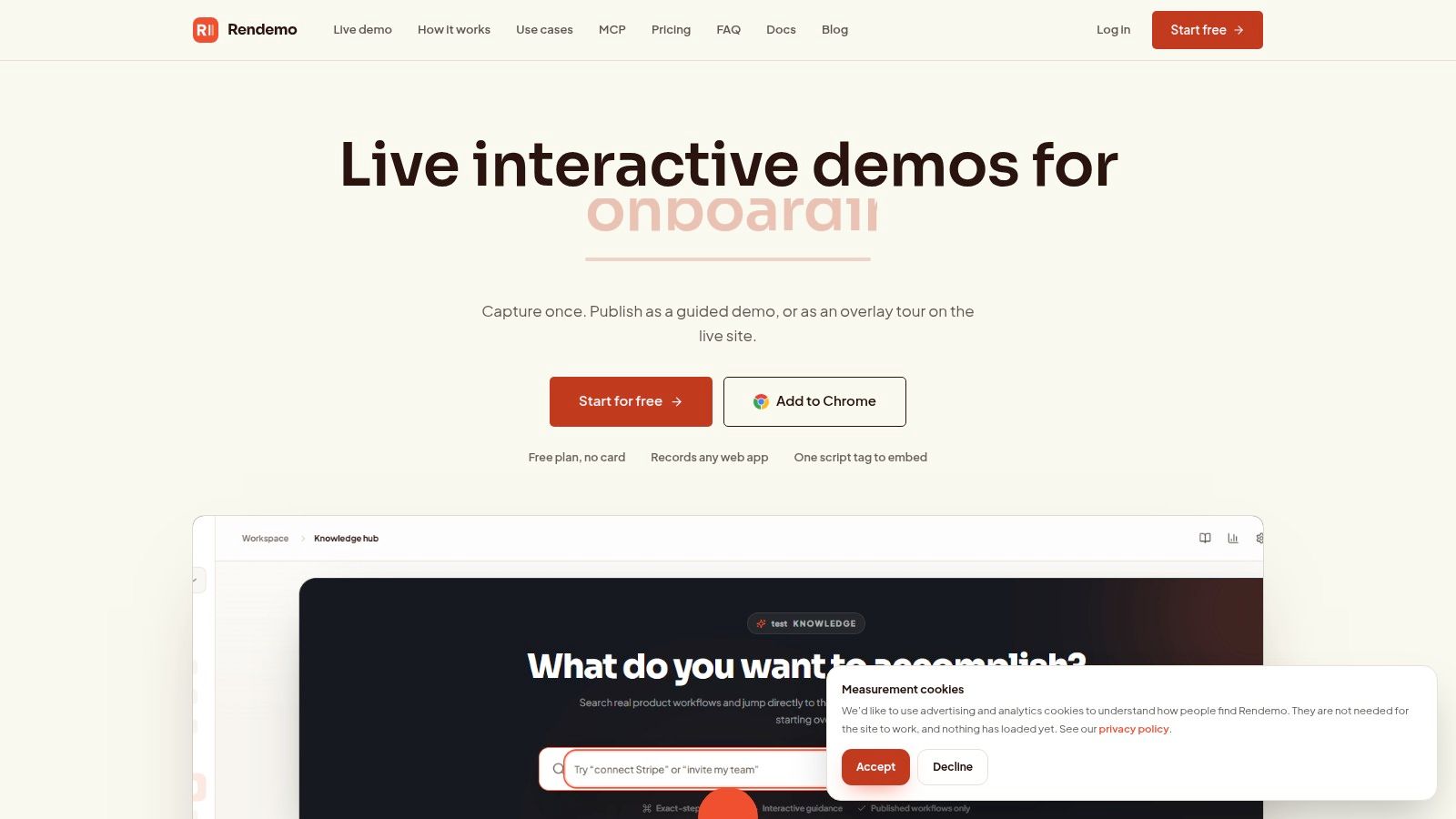
Rendemo is built for a specific enablement problem: sales teams need to show the product, but a static deck or screenshot-based video doesn't let buyers experience the workflow. Its no-code-first platform records real HTML, then turns one capture into a guided interactive demo that viewers can click, type through, and explore.
That capture can become an embedded demo, a shareable link, an overlay tour inside the live web app, or an MP4 export. The workflow is straightforward: record with the Chrome extension, refine the narrative and styling in Studio, then publish. The same asset can support a sales presentation, a follow-up email, onboarding, support documentation, or internal training.
Best for product-led sales enablement
Rendemo suits SaaS product marketing teams, solutions engineers, founders, and customer-facing teams that repeatedly explain the same product paths. Step funnels and content-gap insights show where viewers pause or drop off. Persona variants, branching paths, and optional lead capture help teams adapt the same product story to different buyers without recording everything again.
The operational details are unusually relevant for teams that maintain demos at scale. Every plan includes a built-in MCP server, so compatible agents can generate, lint, and publish demos. Tours-as-code and CI verification can help engineering teams catch broken tours after interface changes. Localization, roles and permissions, Live Guide overlay tours, and priority rendering are available for larger deployments.
Practical rule: If the buyer needs to understand a workflow by doing it, don't judge the tool as a video library. Test whether the interactive experience survives the real sales motion.
Pricing and trade-offs
Rendemo's published pricing is unusually easy to evaluate: Free costs $0, Pro is $39 per month, and Scale is $129 per month, with Enterprise pricing available for SSO, SLA requirements, or unlimited views. The plans use flat per-workspace pricing with unlimited creators, rather than per-seat billing. The free plan includes real-HTML demos, but limits teams to 1 published demo or tour and 1,000 views per month. Pro supports 25,000 views per month, while Scale supports 150,000 views per month. These figures come from Rendemo's published product and pricing information.
The warning is simple. Rendemo isn't a replacement for a full LMS, enterprise content governance suite, or conversation intelligence platform. Recording requires the Chrome extension, and advanced CI, Live Guide, localization, and governance workflows may need engineering involvement. For teams that only need a few static pitch assets, it may offer more flexibility than necessary. For teams that need prospects to interact with the product, that flexibility is the point.
Visit Rendemo to assess the interactive-demo workflow.
2. Highspot
Highspot is strongest when enablement has become a company-wide operating program rather than a content folder. It combines governed content management, sales plays, digital sales rooms, training, coaching, and analytics, giving enablement leaders a way to connect what reps learn with what they do in active deals.
The practical advantage is breadth. A rep can find approved content, follow a structured play, share a buyer portal, complete training, and receive coaching without stitching together several disconnected systems. Highspot also has a mature integration ecosystem with more than 100 integrations, including Salesforce, Microsoft 365, Slack, and alignment with Microsoft Copilot for Sales, as described on the Highspot platform site.
Best for structured enterprise execution
Highspot is a serious candidate for a mid-market or enterprise revenue organization with multiple products, regions, roles, and sales motions. It works particularly well when marketing needs content governance and sales leadership needs visibility into usage, buyer engagement, and coaching in the same system.
Implementation is where the trade-off appears. You'll need clear ownership for taxonomy, approvals, sales-play design, training paths, and CRM data. Uploading a large content library without deciding what should be current, searchable, or retired creates a more expensive version of the original problem.
For a deeper look at the category, compare Highspot's approach with this guide to sales enablement software.
Highspot's pricing is quote-based, and enterprise packaging can become premium as more modules, users, integrations, and governance requirements enter the scope. Ask the vendor to separate platform licensing, implementation, content migration, integrations, and optional AI or coaching capabilities. Highspot is more platform than a small team needs if the immediate problem is just finding the latest pitch deck. It earns consideration when the team needs a governed system for content, coaching, buyer engagement, and execution together.
3. Seismic
Seismic is designed for large organizations that need enablement depth, compliance, extensibility, and tight workflow integration. Its Enablement Cloud brings together content management, digital sales rooms, learning, coaching, analytics, and the Aura AI copilot for guided selling.
The best use case is a complex revenue environment where sellers need current, approved information inside the tools they already use. Seismic's Microsoft 365 and Salesforce integrations can reduce context switching, while Aura supports questions, content creation, translation, and workflow automation. Learning and coaching features add AI role-play and feedback, so enablement doesn't stop at publishing an asset.
Best for governed global scale
Seismic makes sense for a global enterprise with strict brand, legal, product, and regional controls. APIs, CRM-embedded workflows, content governance, and analytics are more important here than a quick standalone launch. Teams can also use digital sales rooms to track how buyers engage with shared content.
The cost is organizational effort. A full-stack deployment can be complex, particularly when content owners, sales operations, learning teams, marketing, and IT all have different requirements. Aura Copilot can also be packaged separately, so confirm exactly which AI features are included rather than assuming the broad platform description covers them.
A good Seismic pilot should test one real sales motion inside the CRM, not a polished library demo.
Pricing is quote-based. Buyers should request a module-level proposal and clarify whether implementation, migration, integration work, coaching, and Aura capabilities are included. Seismic is likely too much platform for a small team with a narrow content problem. It's a stronger fit when scale, compliance, and extensibility matter more than a lightweight first deployment.
4. Showpad
Showpad's advantage is adoption in the field. It combines content management, seller readiness, conversation intelligence, and buyer engagement through Shared Spaces, while keeping the experience accessible for mobile and field sellers.
The platform centralizes governed content, AI search and answers, recommendations, Courses and Paths, Roleplay AI, and buyer-facing digital sales rooms. That combination is useful for teams whose sellers work away from a desk, carry a broad product portfolio, or need a simple way to share approved material during and after meetings. Showpad documents broad CRM and app integrations, along with device and platform coverage, on its official platform documentation.
Best for field-friendly enablement
Showpad is a good fit when the adoption challenge is practical rather than theoretical. Reps need to find the right material quickly, use it on mobile, and share a buyer workspace without learning a complicated internal system. Its help center and feature documentation also make it easier for administrators to understand the product before committing.
The trade-off is scope. Showpad's conversation intelligence may not match a best-of-breed conversation intelligence product, and packaging can affect which features are available at each tier. Pricing isn't publicly listed, so a buyer needs to map the intended workflow to the proposed package instead of evaluating the brand-level feature list.
A sensible implementation starts with one field team, one product line, and a small set of approved assets. Measure whether reps can locate and share content during a normal customer interaction. Don't begin with a company-wide content migration.
Showpad may be more platform than an inside-sales team needs if mobile access and field workflows aren't central. It deserves serious consideration when sellers operate in varied environments and enablement leaders need adoption without forcing everyone into a heavy administration process.
5. Mindtickle
Mindtickle is the readiness and coaching specialist in this group. Its core question is not only whether reps can find content, but whether they have the knowledge, skills, certifications, and deal habits required to execute the sales motion.
The platform includes a Readiness Index for skill benchmarking, personalized learning paths, courses, assessments, instructor-led training, spaced reinforcement through quests, virtual role-plays, and coaching enhancements. It also includes a content hub and digital sales rooms, but those features support the broader readiness model rather than define it.
Best for onboarding and everboarding
Mindtickle fits teams with a formal onboarding program, recurring product changes, certifications, and managers who need a consistent coaching rhythm. A revenue leader can use readiness signals to identify skill gaps, assign learning, practice objections through role-play, and connect coaching to deal execution.
That depth also creates a risk. If the organization hasn't defined its competencies, sales methodology, or manager responsibilities, Mindtickle can become a well-designed training destination that reps visit only when assigned. The platform works best when managers reinforce the behaviors in live deals and one-on-ones.
Use this sales enablement tools guide as a broader reference point when deciding whether readiness or content delivery is the actual bottleneck.
Mindtickle uses quote-based pricing, and total cost can grow as teams add modules. Ask for separate pricing and implementation detail for readiness scoring, learning, coaching, content, digital sales rooms, and AI capabilities. It may be more than a small sales team needs for basic onboarding. For a distributed revenue organization that treats competency as an operating metric, the additional structure can be worthwhile.
6. Guru
Guru solves a specific sales problem: giving reps a current answer without forcing them to search another library. It delivers permission-aware, cited responses through the browser, Slack, Teams, CRM, and other work surfaces.
Its Knowledge Agents search governed company knowledge, while verification workflows give content owners a process for reviewing and maintaining answers. Usage signals reveal which information reps request most often. Guru supports more than 100 integrations, according to Guru's product overview, and MCP delivery lets existing AI tools and agents retrieve governed answers instead of relying on scattered, unverified information.
Best for a single source of truth
Guru fits sales teams that work across product documentation, pricing rules, process guidance, competitive information, and internal answers. It addresses the pull-model problem, where reps must remember that a resource exists before they can search for it.
The harder implementation work is governance. Assign owners to each knowledge area, set review rules, remove contradictions, and define what the AI may answer. If teams publish unchecked material, Guru can make inaccurate information easier to find. For guidance on structuring a help center to feed Guru's knowledge base, see this help-center software guide.
Governance beats volume: A smaller set of verified answers is more useful than an enormous library nobody trusts.
Guru does not replace a digital sales room, product-demo authoring tool, or deep training suite. Teams may need to pair it with one of those systems. Pricing uses package-by-solution engineering, and public seat pricing is not listed, so request a proposal based on the knowledge domains and delivery surfaces you plan to deploy.
Guru may be more platform than a team with clean documentation already embedded in its CRM needs. It deserves serious consideration when reps repeatedly ask the same questions across channels and the business needs one governed answer source.
7. Dock
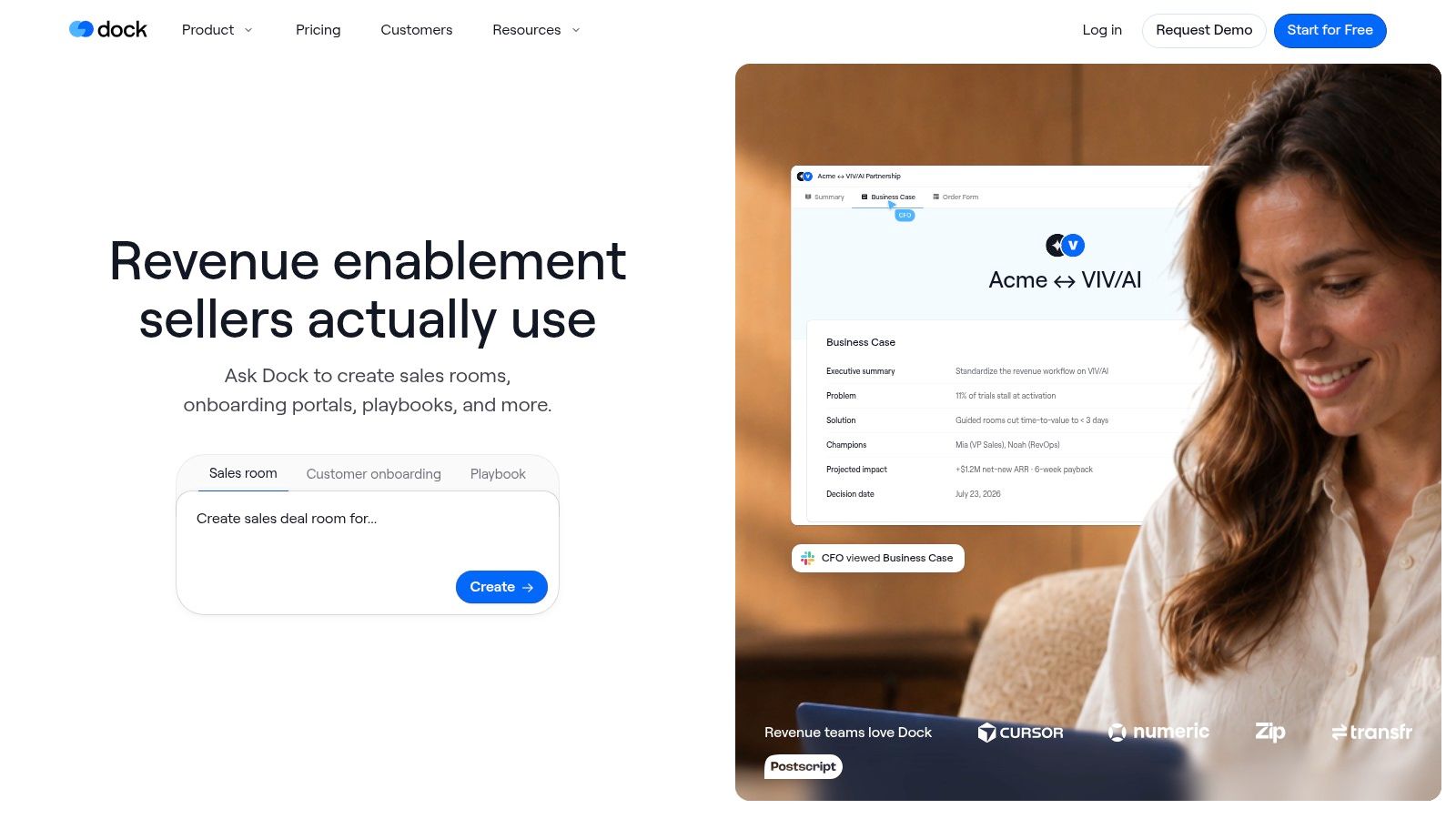
Dock is built around collaborative deal execution. Its digital sales rooms and standardized workspace templates give sellers a repeatable way to organize buyer content, mutual action plans, comments, quotes, order forms, and onboarding steps in one shared environment.
The buyer experience is the center of gravity. CRM data can help personalize workspaces, while engagement analytics show whether stakeholders are viewing and acting on the material. Dock also bridges late-stage sales with onboarding and client success, so the workspace can remain useful after the signature rather than disappearing at close.
Best for buyer workspaces and handoffs
Dock suits sales teams with complex buying committees, many stakeholders, or a clear need to coordinate tasks on both sides of the deal. Mutual action plans, comments, analytics, price quotes, signable order forms, and buyer access controls make it practical for deals where email threads have become the operating system.
The platform is purpose-built, which is both its strength and its limitation. It may need to sit alongside an LMS with deeper learning features or a content governance platform designed for large internal libraries. Advanced automation and API capabilities are also reserved for higher tiers.
Dock publishes pricing, including a free plan, making an initial pilot easier to scope than a fully quote-based enterprise suite. Still, confirm the cost of the CRM integrations, automation, workspace volume, permissions, and any required onboarding support. Dock is more platform than a team needs if its only requirement is sending a proposal. It's a better fit when sellers and buyers need a shared plan, shared evidence, and a clear path from evaluation to implementation.
Top 7 Sales Enablement Tools Comparison
| Product | Implementation Complexity (🔄) | Resource Requirements (⚡) | Expected Outcomes (📊) | Ideal Use Cases (💡) | Key Advantages (⭐) |
|---|---|---|---|---|---|
| Rendemo | 🔄 Low–Moderate, one‑script install; Chrome extension for recording | ⚡ Low, free tier + flat workspace pricing; engineering for advanced CI/Live Guide | 📊 Interactive demos that increase onboarding, support and demo engagement | 💡 Product walkthroughs, sales demos, onboarding, support enablement | ⭐ Real‑HTML interactivity; single‑capture → multiple outputs; built‑in analytics |
| Highspot | 🔄 Moderate–High, governance and integration setup required | ⚡ Medium–High, quote pricing; content program resources | 📊 Better content-to-coaching alignment and measurable sales impact | 💡 Mid-market/enterprise sales enablement with CRM alignment | ⭐ Unified suite; strong Salesforce/Microsoft integrations; training + analytics |
| Seismic | 🔄 High, full‑stack enterprise deployment and governance | ⚡ High, enterprise spend; some AI features may be add‑ons | 📊 Scalable enablement, compliance and reduced rep context‑switching | 💡 Large enterprises needing scale, compliance and extensibility | ⭐ Enterprise-grade breadth; APIs; Aura Copilot for guided selling |
| Showpad | 🔄 Moderate, faster time‑to‑value with mobile/field focus | ⚡ Medium, tiered pricing; strong docs and adoption support | 📊 Faster seller adoption and improved buyer engagement | 💡 Field sellers, mobile-first teams, sales readiness programs | ⭐ Easy to use; strong mobile support; recognized customer satisfaction |
| Mindtickle | 🔄 Moderate–High, learning design, assessments and role‑plays | ⚡ Medium–High, quote pricing; modular costs for features | 📊 Improved rep competency, readiness scores and certification outcomes | 💡 Structured onboarding, continual training and readiness programs | ⭐ Deep training/coaching toolkit; Readiness Index; AI role‑plays |
| Guru | 🔄 Low–Moderate, integration and verification workflows to set up | ⚡ Low–Medium, packaged pricing; wide integrations | 📊 Faster time‑to‑answer, reduced ramp and fewer errors | 💡 In‑flow knowledge for reps (Slack/CRM/browser) and process docs | ⭐ Verified, permission‑aware answers; strong governance and delivery |
| Dock | 🔄 Low–Moderate, quick to stand up DSRs and templates | ⚡ Low–Medium, transparent pricing with free plan | 📊 Faster deal execution, clearer engagement signals, smoother handoffs | 💡 Deal collaboration, digital sales rooms, onboarding & client portals | ⭐ Fast DSR setup; CRM auto-personalization; bridges sales→CS workflows |
Choose the Bottleneck, Then Pilot the Workflow
The right choice depends on the work that currently breaks down. Choose Rendemo when prospects need to interact with the product through clickable demos, guided experiences, or live overlay tours. Choose Highspot or Seismic when a larger organization needs broad enterprise enablement across content, coaching, buyer engagement, governance, and analytics.
Choose Showpad when field sellers need an accessible, mobile-friendly experience that encourages adoption. Choose Mindtickle when the central problem is readiness, onboarding, certification, role-play, and manager-led coaching. Choose Guru when reps can't get a reliable answer in the flow of work. Choose Dock when sales and buyers need a collaborative workspace for mutual action plans, content, quotes, and handoffs.
The category itself is no longer niche. One 2026 estimate values the sales enablement platform market at USD 5.23 billion in 2024 and projects USD 12.78 billion by 2030, with a 16.3% compound annual growth rate from 2025 to 2030, while another estimate puts the market at USD 4.21 billion in 2025 and forecasts USD 12.35 billion by 2031, implying 19.65% CAGR during 2026 to 2031. Both forecasts identify North America as the largest market and Asia Pacific as the fastest-growing region in their respective reports, as summarized by Grand View Research's market analysis. That growth gives buyers more choice, but it also makes tool sprawl easier.
Run a focused pilot before buying a broad suite.
- Select one workflow: Pick a real use case, such as a product demo follow-up, new-hire readiness path, competitive answer in Slack, or mutual action plan.
- Define the bottleneck: Write down whether the problem is missing knowledge, inconsistent behavior, weak coaching, poor buyer coordination, or an unclear product experience.
- Test the representative integration: Use the actual CRM, browser, collaboration tool, or web app your reps rely on. Don't accept a simulated integration review.
- Confirm commercial scope: Ask the vendor to separate licensing, modules, implementation, migration, integrations, AI features, and support.
- Measure usage or progression: Track whether reps use the workflow and whether buyers or managers move forward. Don't rely on feature counts or training completion alone.
The strongest buying decision isn't the platform with the longest feature list. It's the tool that removes friction from a specific workflow, fits the team's operating model, and produces evidence that people will keep using it.
Rendemo lets sales and solutions teams turn real product workflows into clickable HTML demos, guided tours, live overlay experiences, shareable links, or video exports from one capture. If interactive product experiences are the missing layer in your enablement motion, visit Rendemo and test the workflow with your own product.
See it instead of reading about it
Record one workflow from your real product and publish a clickable demo anyone can follow. Real-HTML capture is on the free plan.
Start free