7 SaaS Sales Tools for a Practical Revenue Stack
· 20 min read
Most SaaS sales teams don't need seven overlapping platforms. They need clear ownership across the demo experience, CRM, prospecting, engagement, coaching, and forecasting. The best stack is the one that makes each handoff obvious, not the one with the longest feature list.
This roundup evaluates saas sales tools by their primary job, implementation friction, integration depth, and strongest pairing. CRM adoption is already mainstream among larger companies, with about 91% of businesses with 10 or more employees using a CRM, compared with roughly 50% of businesses with fewer than 10 employees (NordicsCRM's 2026 CRM statistics). That gap helps explain why many startups start with lightweight tools, then add governance and specialist layers as the revenue team grows.
The practical question is whether a tool improves a measurable handoff. Rendemo can connect the product-experience layer to sales, onboarding, support, and enablement workflows, while Salesforce and HubSpot organize customer records, Outreach and Salesloft manage engagement, Gong analyzes conversations, and Clari inspects revenue risk.
Table of Contents
- 1. Rendemo
- 2. Salesforce Sales Cloud
- 3. HubSpot Sales Hub
- 4. Outreach
- 5. Salesloft
- 6. Gong Revenue Intelligence
- 7. Clari Revenue Orchestration Platform
- Top 7 SaaS Sales Tools Comparison
- Build Around Handoffs, Not Feature Counts
1. Rendemo
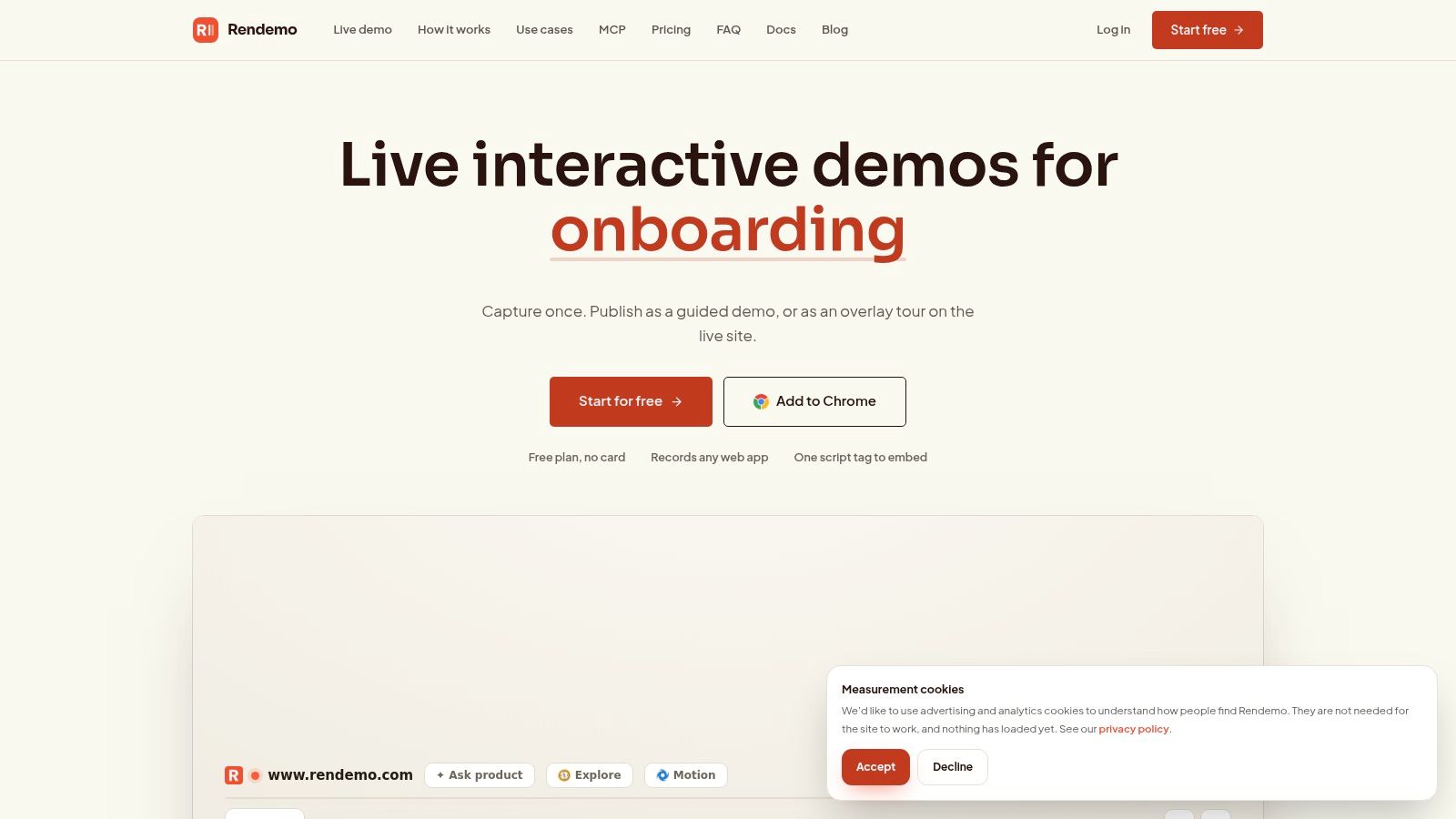
A CRM can store demo activity, but it cannot give every buyer a useful product experience. Rendemo handles that missing layer by helping prospects understand a SaaS product before, between, and after sales conversations. It creates real-HTML interactive walkthroughs that run on marketing sites or inside web apps. Viewers can click, type, and explore a guided workflow rather than watch a passive video or move through screenshots.
The Chrome extension records clicks, fields, and UI state. In Studio, teams can edit the narration, apply branding, direct attention, and adapt the experience to a persona or use case. One capture can become an embedded guided demo, a shareable link, a Live Guide overlay on the product, or an MP4 export. That reuse reduces duplicated work across sales, onboarding, support, and enablement, where the same workflow is often explained repeatedly in different formats.
Where Rendemo fits
Rendemo fits the product-experience job in a SaaS sales stack. Marketing can place an interactive workflow on a landing page, sales can send a personalized link after a discovery call, and customer success can reuse the same capture during onboarding. Its analytics show step funnels and content gaps, helping teams see where viewers pause or leave instead of guessing why a demo loses momentum.
One analyzed sample reported a 7.9x website conversion lift, with conversion moving from 3.05% to 24.35% among visitors who engaged with the demo (Storylane's analyzed sample). Separate survey data associated interactive demos with about 10% to 20% of inbound lead volume and a 20% to 25% increase in website conversion rate (Navattic's 2025 report). These results are directional, not a forecast for every implementation. They do show why an interactive demo can complement the CRM instead of sitting outside the sales process.
Practical rule: Use Rendemo when the buyer needs to experience a workflow, not merely hear a feature description.
Rendemo's free plan includes real-HTML interactive demos, one published demo or tour, and up to 1,000 views per month. Pro costs $39 per month per workspace, with unlimited creators, up to 25,000 views per month, analytics, persona variants, branching, and lead capture. Scale costs $129 per month, supports up to 150,000 views per month, and adds Live Guide overlays, localization, roles and permissions, and priority rendering. Enterprise adds SSO, SLA, unlimited views, and other custom controls. The Rendemo website lists these pricing details and competitor comparisons as of 30 July 2026.
Every plan includes a built-in MCP server for agent workflows such as Claude Code or Codex. Tours-as-code and CI verification can catch broken markers after product changes, which matters for teams that update their application frequently. The trade-offs are practical: recording depends on the Chrome extension, highly customized applications may need engineering support, and view limits become more significant as distribution expands.
Pair Rendemo with the CRM and engagement layer rather than treating it as a standalone replacement. Send demo engagement into qualification workflows, then let Outreach or Salesloft manage structured follow-up. Teams assessing the category can also consult this guide to software sales demos.
Pros
- Authentic product experience: Viewers interact with real HTML rather than video or screenshot playback.
- Predictable pricing: Flat workspace pricing with unlimited creators avoids per-seat expansion costs.
- Reusable capture: One workflow can become an embed, overlay tour, shareable link, or video.
- Operational safeguards: MCP support, tours-as-code, and CI verification support technical teams.
Cons
- View limits: Free, Pro, and Scale plans cap monthly views, while unlimited views require Enterprise.
- Recording workflow: The Chrome extension is central to authoring, and complex workflows may need technical help.
- Not a CRM replacement: Rendemo improves product communication, while customer records and opportunity ownership remain elsewhere.
2. Salesforce Sales Cloud
Salesforce Sales Cloud is the heavyweight system of record in this stack. It organizes leads, accounts, contacts, opportunities, forecasts, quotes, territories, and sales-process automation for companies that need shared rules across teams.
The main advantage is configurability. Administrators can represent different sales motions, business units, industries, approval paths, and reporting structures in one CRM. Einstein and Agentforce add AI assistants and agents around CRM objects, workflows, and analytics. The marketplace and partner ecosystem extend those capabilities into industry-specific operations.
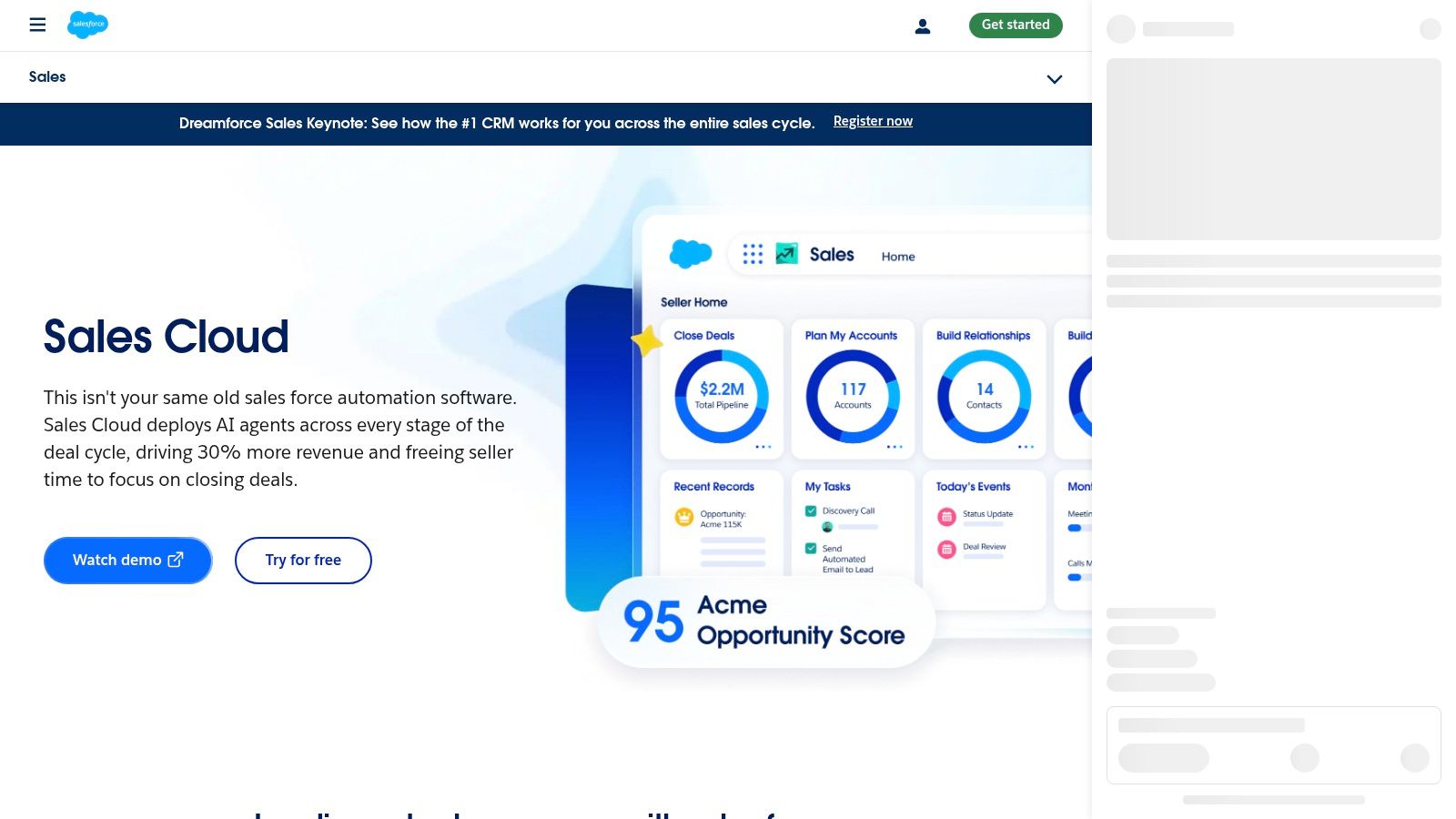
Salesforce earns its place when several functions need the same customer record. Revenue operations can define opportunity stages, sales leaders can inspect pipeline, finance can connect quoting processes, and executives can compare forecasts using shared definitions. It also gives a growing company room to support acquisitions, regional expansion, or multiple product lines without replacing the CRM.
That room has a cost. Implementation involves object design, permissions, automation rules, data standards, and ongoing admin ownership. If those decisions remain unclear, representatives may treat Salesforce as a required activity log instead of a tool that guides their work. Required fields and custom workflows need to reflect the actual sales motion, or adoption will suffer.
Salesforce is powerful when the business has a clear operating model. It won't create one by itself.
Use Salesforce as the record layer, not as the entire sales stack. Rendemo can pass product-engagement signals into qualification or routing workflows, while the account record remains the source for ownership and next steps. Outreach or Salesloft can manage structured engagement, and Gong or Clari can cover conversation or forecast review when those functions solve a defined gap.
The practical choice is pairing, not feature accumulation. Salesforce handles governance and customer context; specialized tools handle the repetitive engagement and inspection work around that record.
Pros
- Deep configurability: It supports complicated sales processes, territories, approval paths, and reporting.
- Enterprise governance: Security, administration, and workflow controls suit larger organizations.
- Broad ecosystem: Integrations and industry editions reduce the need to build every extension internally.
Cons
- Implementation burden: Teams often need dedicated admin or operations support.
- Packaging complexity: Editions, modules, and contract structures can make costs difficult to compare early.
- Adoption risk: A heavily customized CRM can frustrate representatives when required fields and workflows do not match how they sell.
3. HubSpot Sales Hub
HubSpot Sales Hub suits teams that would rather start selling than design an elaborate CRM administration model. Built on HubSpot's Smart CRM, it brings prospecting, sequences, meeting scheduling, playbooks, pipeline management, conversation intelligence, and forecasting into one environment.
Its strongest advantage is a short path from setup to usable workflow. A smaller SaaS company can create a pipeline, assign owners, schedule meetings, and track activity without first defining a complex enterprise data model. Sales teams also retain marketing and service context around the same contact and company records, which helps when a lead moves between acquisition, qualification, and expansion.
HubSpot fits founder-led sales and growing inside sales teams that want one connected go-to-market platform. Revenue Hub adds CPQ and billing capabilities. Professional and Enterprise tiers provide more advanced forecasting and deal journey analytics, but they also introduce higher package costs and one-time onboarding fees. The free tier and transparent per-seat pricing simplify early budgeting, yet the initial price is not the full cost of an advanced deployment.
The main constraint is process complexity. Teams with specialized permissions, custom objects, or elaborate approval logic may need workarounds, while enterprise CRMs can offer deeper governance and customization. Tier selection therefore matters as much as the feature list.
For product-led or marketing-led sales, pair HubSpot with Rendemo. Place the interactive demo beside educational content, capture engagement in the CRM, and start a sequence only after the prospect shows a relevant signal. For heavier outbound, Outreach or Salesloft can add structured engagement, but that creates another operating surface and should address a defined workflow gap.
Pros
- Fast adoption: Core CRM and sales workflows can run with less administrative overhead.
- Connected customer data: Sales, marketing, and service context stay around shared contact and company records.
- Accessible entry point: A free tier and transparent per-seat pricing make early planning easier.
Cons
- Governance ceiling: Complex enterprise customization may be less flexible than Salesforce.
- Tier dependence: Advanced forecasting and analytics require higher packages.
- Onboarding cost: Professional and Enterprise plans include one-time onboarding fees.
4. Outreach
Outreach handles the engagement job in a SaaS sales stack. It coordinates multichannel sequences across email, voice, social, and SMS, then adds testing, analytics, task management, conversation intelligence, deal inspection, and forecasting around rep activity.
The practical benefit is consistent execution. Managers can define a sequence, assign tasks, monitor completion, and check whether follow-up matches the intended rhythm. AI-assisted messaging and agent features can help create content or automate workflows, although results still depend on clean CRM data and useful segmentation.
A typical workflow might start with account selection in the CRM, move into Outreach for coordinated follow-up, and return engagement signals to the opportunity record. That division keeps the engagement layer focused, while the CRM remains the source of truth.
Where Outreach fits
Outreach suits structured outbound and account-based motions that require more control than basic CRM sequences. It can coordinate follow-up across a large team and connect with core sales systems. Its reporting also gives managers a view of activity and engagement patterns, rather than leaving sequence performance to individual rep judgment.
The main friction is commercial and organizational. Pricing is custom and quote-based, while consumption or modular packaging can make budgeting harder. Outreach also overlaps closely with Salesloft, so a platform change involves more than comparing feature lists. Teams may need to migrate sequences, field mappings, reporting definitions, manager routines, and rep workflows.
Targeting quality sets the ceiling. If the ICP is unclear or account records are unreliable, adding sequences increases noise instead of improving coverage.
Pairing Rendemo with Outreach gives the engagement workflow a clearer trigger. A prospect can receive a relevant product walkthrough, then enter a follow-up path based on the workflow they explored. Teams comparing product demo tools can assess demo creation software alongside conventional engagement platforms.
Best use: Let Outreach manage follow-up rhythm, the CRM own the record, and product engagement supply context for the next message.
Pros
- Deep sequencing: Multichannel rhythms, testing, and analytics support organized outbound.
- Rep productivity: Tasks, messaging assistance, and workflow automation reduce manual coordination.
- Integration depth: It fits established CRM and revenue technology ecosystems.
Cons
- Budget uncertainty: Quote-based pricing and modular packaging make early cost modeling harder.
- Change management: Moving from or to Salesloft affects processes, mappings, and rep habits.
- Data dependency: Poor targeting and stale CRM records weaken the engagement motion.
5. Salesloft
Salesloft is built for the execution layer of a SaaS sales stack. Its cadences, dialer, conversation intelligence, deal inspection, forecasting, and Rhythm views help reps choose their next action while giving managers evidence about deal progress. The product suits teams that want engagement and inspection connected, rather than a sequencing tool operating beside a separate coaching system.
Rhythm can prioritize work, while deal and forecast views connect rep activity with pipeline quality. Marketplace integrations, including ZoomInfo and DocuSign, extend the workflow from data enrichment to meetings and contracting. That breadth reduces tool switching, though it also increases configuration work and makes ownership less obvious across teams.
A sales leader should choose Salesloft when the operating problem is inconsistent follow-through or weak visibility into active opportunities. It is less compelling when the team mainly needs contact data, since separate enrichment and account-intelligence providers may still be required. Quote-only pricing also makes early budget comparisons difficult, so buyers should model licenses, adjacent data products, implementation, and manager adoption together.
The useful pairing is straightforward: Salesforce or HubSpot remains the system of record, Salesloft manages outreach, and Rendemo handles buyer-facing product education. After discovery, a rep can send an interactive workflow, see which part needs clarification, then place the relevant stakeholders into a focused cadence. Teams assessing sales enablement tools should separate content reuse from rep productivity, because Salesloft primarily addresses the latter.
Best fit: Teams that need structured engagement plus manager-level deal inspection.
Strengths
- Mature cadences: Sequences, calling, and activity guidance support repeatable engagement.
- Coaching context: Conversation intelligence and deal inspection add context beyond activity totals.
- Partner coverage: Marketplace integrations connect data, meetings, documents, and contracts.
Trade-offs
- Opaque budgeting: Quote-only packaging complicates early comparisons.
- Data dependencies: Separate enrichment providers may remain necessary.
- Platform overlap: Comparing Salesloft with Outreach requires reviewing workflows, migration effort, and adoption, not just feature lists.
6. Gong Revenue Intelligence
Gong is built around the evidence inside sales conversations. It captures calls, meetings, and emails, then uses AI to identify themes, deal risks, coaching opportunities, and recurring patterns that CRM fields rarely show. Its expansion into Engage and Forecast gives Gong a wider role across revenue workflows, though teams should still validate whether those modules fit their operating model.
The practical use case is specific. A sales leader can see where opportunities lose momentum, while a frontline manager can review the exact moment a rep missed a stakeholder, failed to test business pain, or left next steps unclear. Gong turns those interactions into material for inspection and coaching, rather than adding another activity dashboard.
Gong earns its place when managers lack visibility into deal quality or coaching is inconsistent. Role-specific views, including Deal Spotlight, help teams focus on individual opportunities and recurring patterns across the pipeline. That visibility only matters if managers review calls regularly, agree on what good discovery or qualification looks like, and change rep behavior based on the findings.
Recordings do not create improvement by themselves. Gong also requires management time, adoption across the team, and a coaching process that connects conversation evidence to CRM actions. Pricing is not public, and contracts commonly combine per-user licenses with a platform fee. Buyers should therefore model implementation and ongoing management alongside seat costs.
A workable stack assigns each product a clear job. Salesforce or HubSpot can hold account and opportunity records, Gong can examine conversation quality, and Outreach or Salesloft can run engagement workflows. Rendemo supports the earlier buyer-education stage with self-guided product explanation, while Gong helps the team learn from the conversations that follow.
Conversation intelligence is only valuable when a manager changes a behavior because of it.
Best fit: Teams that need conversation-based coaching and more disciplined opportunity inspection.
Strengths
- Strong conversation analysis: AI-generated insights support call review and coaching.
- Deal visibility: Role-specific inspection helps managers focus on opportunity health.
- Broader platform direction: Engage and Forecast may reduce the need for separate systems.
Trade-offs
- Management dependency: Teams need active coaching and inspection habits.
- Pricing complexity: Per-user licensing plus a platform fee can complicate budgeting.
- Expansion risk: Buying additional modules before proving the core conversation workflow can increase cost and adoption work.
7. Clari Revenue Orchestration Platform
Clari addresses a management question that spreadsheets and CRM dashboards often leave unresolved: can the company trust its pipeline and forecast? The platform combines pipeline management, risk inspection, forecasting, sales productivity, and retention or expansion workflows through Revenue Context and AI agents.
Its main contribution is a shared operating model for revenue inspection. Clari connects with Salesforce and other systems, captures activity to improve CRM data quality, surfaces risk signals, and presents role-specific views for reps, managers, executives, and boards. That makes it useful when the problem is inconsistent inspection, not just a missing forecast chart.
Where Clari earns its place
Clari fits organizations where forecast calls consume too much time or where sales, customer success, and finance apply different definitions of pipeline health. A common inspection cadence gives managers a consistent way to review deals and identify risk before quarter-end pressure arrives.
The platform can be excessive for a startup with a small pipeline and a straightforward sales motion. Clean CRM stages, agreed definitions, and regular manager reviews may address the immediate problem with less implementation work. Clari pricing is not public, and integrations and modules affect the quote, so buyers should define the forecasting or pipeline-quality issue before comparing proposals.
Clari works best as an inspection layer in a broader stack. Salesforce can remain the underlying record, Gong can supply conversation evidence, and Outreach or Salesloft can execute engagement workflows. Rendemo belongs earlier, where interactive product engagement can qualify interest and give sales more context before an opportunity enters a forecast category.
The trade-off is operational discipline. Clari can expose weak definitions and incomplete data, but it cannot resolve disagreements about stages or inspection rules by itself.
Pros
- Forecasting depth: Pipeline and AI forecasting support structured revenue inspection.
- Executive visibility: Risk workflows extend from rep-level views to board-level reporting.
- Data quality focus: Capture and context features help standardize CRM information.
Cons
- Platform weight: Teams seeking only a narrow forecasting feature may carry unnecessary complexity.
- Quote-based pricing: Integrations and modules make comparisons difficult without a detailed proposal.
- Implementation discipline: Forecast improvements depend on shared definitions and consistent inspection rules.
Top 7 SaaS Sales Tools Comparison
| Product | Implementation 🔄 | Resources & Speed ⚡ | Expected Outcomes 📊 | Ideal Use Cases 💡 | Key Advantages ⭐ |
|---|---|---|---|---|---|
| Rendemo | Low–Moderate, Chrome recorder + Studio; tours-as-code optional | Low engineering overhead; fast publish; free tier but view limits | Interactive, reusable demos; fewer support tickets; faster onboarding | Product marketing, onboarding, support, sales demos, CI-verified tours | Real‑HTML interactive demos; flat per‑workspace pricing; one-capture→many-outputs; built-in MCP/CI |
| Salesforce Sales Cloud | High, extensive config, admin & governance required | High resource needs (admins, integrations); slower time-to-value | Single source of truth for CRM, robust forecasting & pipeline management | Large enterprises, regulated industries, complex sales orgs | Extremely configurable; large partner ecosystem; mature governance & security |
| HubSpot Sales Hub | Low–Moderate, plug-and-play for SMBs; add-ons for advanced needs | Moderate resources; quick time-to-value; transparent per-seat pricing | Faster adoption; solid pipeline management & conversation intelligence | SMBs, fast-growing teams, marketing-aligned sales orgs | Transparent pricing; free tier; lower admin burden; integrated prospecting tools |
| Outreach | Moderate–High, sequence design and integration work | Moderate resources with consumption-based AI; tailored pricing | Scaled outbound engagement; improved cadence & forecasting | High-volume outbound teams, sales ops focused on scaling sequences | Deep multichannel sequencing; A/B testing; AI-assisted messaging & automation |
| Salesloft | Moderate–High, cadence setup, dialer integration, enablement tooling | Moderate resources; requires rep adoption and training | Improved rep productivity, coaching, and cadence execution | Teams focused on cadence-driven outreach and call-heavy workflows | Mature sequencing, integrated dialer, “Rhythm” views, broad integrations |
| Gong (Revenue Intelligence) | Moderate, capture instrumentation and manager coaching required | Moderate resources; ongoing recording/storage; per-user licensing typical | High-quality conversation insights, coaching impact, deal/forecast health | Coaching-centric sales orgs, revenue intelligence initiatives | Market-leading call analysis; strong coaching workflows; unified revenue insights |
| Clari (Revenue Orchestration) | Moderate–High, CRM integrations and data alignment needed | High data/integration effort; quote-based pricing; enterprise scope | Improved forecasting, risk detection, alignment from rep to board | Orgs needing accurate forecasting and exec-level revenue visibility | Strong forecasting & risk detection; revenue context; inspection cadence |
Build Around Handoffs, Not Feature Counts
The right stack starts with one system of record, one primary engagement motion, and only the intelligence or demo layers that address a visible workflow gap. Many teams don't need both Outreach and Salesloft, for example. They need one tool that owns outbound execution, reliable CRM synchronization, and a manager-approved process.
Start by mapping the handoffs. An interactive demo can create product-interest context that flows into the CRM. CRM qualification can route a prospect into Outreach or Salesloft. Call insight can feed coaching and deal inspection in Gong, while Clari can turn opportunity evidence and pipeline data into a forecast view. The tools work together only when each handoff has a clear owner, trigger, and expected next action.
The broader category is large enough that tool sprawl is now a practical buying risk. The global CRM software market is estimated at roughly $90 billion to $110 billion in 2026, and SaaS or cloud delivery accounts for more than 95% of new CRM deployments (NordicsCRM's 2026 market overview). The wider sales software market is estimated at $35.9 billion in 2026, up from $31.26 billion in 2025, with a projection of $71.83 billion by 2031 and a projected 14.86% CAGR from 2026 to 2031 (AM World Group's CRM statistics). More available software doesn't make selection easier. It makes ownership more important.
A practical selection sequence
- Define the record: Decide whether Salesforce, HubSpot, or another CRM owns accounts, contacts, opportunities, stages, and next steps.
- Choose the motion: Select Outreach or Salesloft only if the team needs dedicated multichannel engagement beyond the CRM.
- Add buyer experience: Use Rendemo when prospects need to explore product workflows without waiting for a live rep.
- Add conversation intelligence: Choose Gong when managers need evidence for coaching and deal inspection.
- Add forecast orchestration: Choose Clari when pipeline risk, forecast consistency, and executive visibility are recurring problems.
Adoption matters as much as capability. Sales engagement software is already used by 65% of sales organizations, compared with 52% in 2020, while 82% of B2B sales teams use these tools to improve prospect engagement and 90% of enterprises use them for lead nurturing (World Metrics' sales engagement statistics). That adoption doesn't mean every team needs the same platform. It means buyers should test whether a new tool fits an established workflow or merely adds another place for reps to work.
Longer buying cycles make this distinction sharper. Recent coverage places the average B2B SaaS sales cycle at 134 days in 2025, compared with 107 days in early 2022 (Sales Performance's SaaS sales trends). Automation alone won't solve a slower, multi-touch decision. Product signals, sales conversations, self-serve evaluation, and forecast inspection need to connect.
Document the buyer journey, assign one tool to each stage, and pilot the smallest pairing that improves a specific handoff. Measure adoption, data quality, and ownership before adding another platform.
Rendemo turns real product workflows into clickable, embeddable demos, Live Guide overlays, shareable links, and video exports that sales, onboarding, support, and enablement teams can reuse. If your current stack loses context between product interest and sales follow-up, visit Rendemo and test a lighter product-experience layer.
See it instead of reading about it
Record one workflow from your real product and publish a clickable demo anyone can follow. Real-HTML capture is on the free plan.
Start free